How to Install Gym Mirrors

Gym mirrors require safety-backed glass, verified wall support and specialist installation. This guide explains how to install gym mirrors as a planning and specification exercise, not a do-it-yourself glass-handling tutorial. Anyone asking how to install a gym mirror needs to start with the wall and the complete fixing system rather than choosing adhesive first. GymMovers.co.uk can discuss specialist mirror installation, and the guides library covers related room planning. Specify documented BS EN 12600 impact performance and suitable Class B or A safety backing, with the terminology confirmed by the supplier for the particular glass assembly.
Specify safety-backed glass with documented performance
Gym mirrors should be selected as a safety-backed glass system, with evidence relevant to the intended installation. Ask for the stated BS EN 12600 impact classification of the supplied assembly and confirmation of the Class B or A safety backing being specified. Supplier descriptions of backing grades are not, by themselves, a substitute for documented glass impact performance. The specialist should verify that the product, backing and installation method belong together.
Safety backing is intended to help retain fragments if the glass breaks; it does not make a mirror unbreakable or eliminate the need for secure support. Keep mirrors away from likely equipment impacts and plan suitable separation from free weights and moving machine parts. Check sheet dimensions, exposed edge treatment and any cut-outs before manufacture. Do not substitute ordinary unbacked mirror glass because it looks identical from the front. Retain the product documentation so future replacements can be specified against the original safety requirements rather than appearance alone.
Survey masonry and stud plasterboard walls structurally
A wall survey must establish what will carry the mirror load. Sound masonry may provide suitable fixing locations, but the installer still needs to consider the material, condition, anchor selection and edge distances. Plaster or a decorative finish is not proof of a sound base. Cracks, hollow areas, dampness or loose coatings need investigation before rails or adhesive are installed.
Stud plasterboard requires identification of framing and any suitable structural backing. Do not assume ordinary plasterboard plugs will support large gym mirror sheets or that adhesive applied to paint solves the load path. The proposed rail and clip fixings must connect to support appropriate for the complete system. Where backing needs adding or the wall's capacity is uncertain, arrange suitable building work or professional assessment before glass is ordered. Check concealed services before drilling. A specialist installation begins by verifying the wall and its fixings, not by deciding how to conceal an unreliable substrate behind reflective glass.
- Safety-backed glass has documented BS EN 12600 performance and suitable backing classification.
- Structural wall-fixing checks cover masonry or the stud-and-backing arrangement.
- Rails, top clips and mirror-safe adhesive form an approved compatible system.
- Specialist handling, expansion gaps and handover records are agreed.
Plan mirror dimensions and training-room clearances
Map the mirror wall against actual activities, equipment travel and circulation. Allow for sockets, switches, skirting, ventilation and access panels without assuming they can be covered. Mirrors should not obstruct required maintenance or create exposed vulnerable edges next to moving equipment. Large sheets can reduce the number of joints but increase handling demands and may be unsuitable for the delivery route or available wall support.
Use the gym mirror wall planner to organise dimensions and sheet layout before discussing the design with an installer. Its output supports planning; it does not certify the wall, determine anchors or replace an accurate site measurement. Record door widths, turns, stairs and lift dimensions as well as the finished wall area. For a home gym installation, consider adjacent living spaces and room use outside training. Confirm the final glass sizes only after the specialist has checked tolerances, edge details and access for safe handling.
Set out a level support line with a laser
A laser level helps the installer establish a consistent datum across the wall. It does not prove that the wall is flat or structurally adequate. The survey should also identify bows, local high points and changes of plane that could load the glass unevenly or create a distorted reflection. Approved packers or substrate correction may be needed as part of the chosen system.
Agree the bottom and top lines, joint positions and clearances before drilling. Check the proposed height against skirting, equipment and the required viewing area rather than following an arbitrary dimension. Adjacent mirror sheets should be set out to align without being forced into contact. Avoid positioning fixings where they cannot engage adequate support or where hidden services are present. When people search for how to install gym mirror panels neatly, accurate setting out is only one part of the answer: the support beneath those alignment lines must also be suitable and verified before any glass is brought to the wall.
Installation and handling sequence
Survey and specify
Have a specialist verify wall construction, structural fixing locations and access. Confirm documented BS EN 12600 performance and suitable Class B or A safety backing before glass is ordered.
Approve the layout
Check sheet sizes, equipment clearances and the delivery route. Agree laser-levelled support lines, the approved J-channel system, top retention and required expansion gaps before installation begins.
Install with trained handlers
Use a planned specialist lift with suitable suction equipment and enough trained people. Follow the approved rail, setting-block, clip and mirror-safe neutral-cure adhesive requirements without stressing the glass.
Inspect and document
Keep the area isolated until support and curing requirements are satisfied. Review alignment, edges and retention, then retain safety documentation and maintenance guidance for future inspection or replacement.
Specify the aluminium J-channel and compatible adhesive
An aluminium J-channel bottom rail can provide continuous support where it forms part of the approved mirror system. The installer must select the rail, fixings and any setting blocks for the glass dimensions, weight, wall and backing. Rail fixings need structural support; adhesive is not a remedy for an inadequately anchored channel. Protect the glass from direct damaging contact with metal as required by the system instructions.
Where adhesive is specified, use a mirror-safe low-modulus neutral-cure product approved for the particular mirror coating, safety backing and substrate. Never use acidic silicone. Even a product labelled neutral cure needs compatibility confirmation because not every sealant is suitable for mirror backing or structural use. The specialist should follow the prescribed application pattern, ventilation, cure conditions and temporary support requirements. Do not invent a bead spacing or assume extra adhesive improves safety. For gym mirror installation, ask for the complete support and retention method to be identified in the written scope.
Use specialist two-person suction-cup handling and top retention
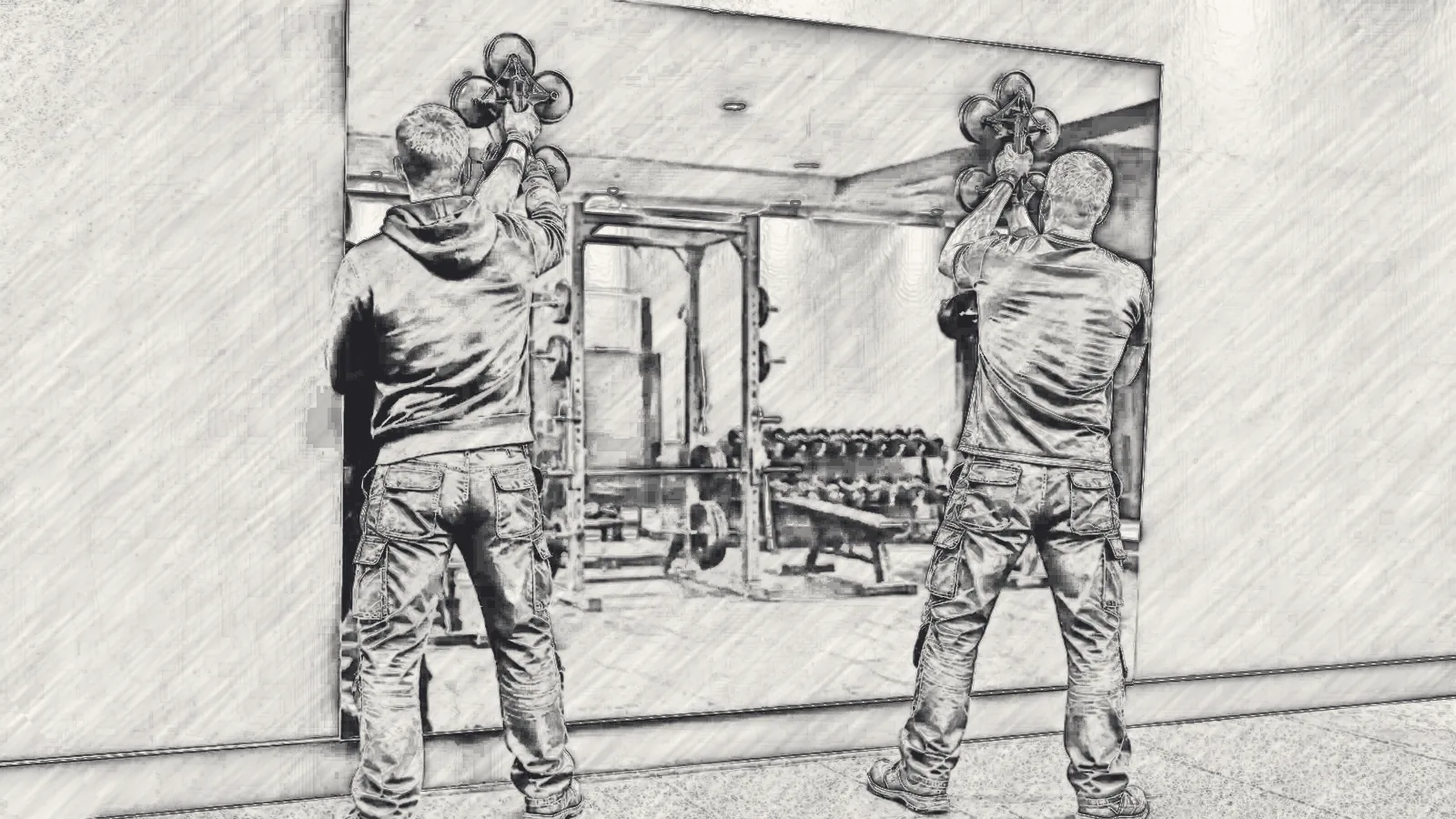
Large mirror sheets need a planned handling method, clear routes and suitable equipment. Suction-cup handling by at least two trained people is appropriate only where the sheet size, weight and access permit it; larger or more complex lifts may need additional personnel or lifting aids. Suction devices must be suitable, checked and used according to their instructions. They are handling aids, not permission to work beneath unsecured glass.
The specialist should control positioning into the bottom rail without knocking corners, twisting the sheet or trapping fingers. Top clips or other specified retention then prevent the mirror moving out of its support, subject to the system design. Clips must retain without over-tightening or point-loading the glass. Temporary support and exclusion arrangements remain necessary until the installation is secure and any adhesive has cured as required. Keep gym users and unrelated contractors outside the work area. No part of the handling sequence should depend on someone holding a heavy sheet indefinitely while missing fixings are found.
Maintain expansion gaps and prevent optical distortion
Glass, framing and the building can respond differently to environmental changes. The system therefore needs the edge and inter-panel clearances specified by the manufacturer and installer. Do not push sheets tightly together or fill every gap with an unapproved sealant. Required expansion gaps also help avoid glass-to-glass contact and pressure at edges when neighbouring elements move.
A distorted reflection may arise from uneven support, wall irregularity, unsuitable adhesive application or stress imposed by fixings. It should not be dismissed automatically as normal for a large mirror. The installer should review alignment and support without forcing a sheet to follow a bowed wall. At handover, check reflections from normal training positions, inspect edge protection and confirm top retention and rail finishing. These visual checks complement, rather than replace, documented structural wall-fixing checks and the agreed safety-backed glass specification. If glass cracks, shifts or becomes loose, isolate the area and arrange specialist assessment instead of trying to tighten clips yourself.
Book specialist installation and keep the handover records
Searches for how to install gym mirror on wall often focus on which adhesive to buy. The safer question is whether the complete wall, glass, backing, rail and retention system has been verified together. Booking specialist GymMovers.co.uk mirror installers helps address the causes of distortion and wall-fixing failure through survey, compatible specification and controlled handling, rather than relying on a neat-looking finish as evidence of security.
Send photographs, wall dimensions, known construction details and access information through the contact page. Ask for a fixed written quote defining the safety-backed glass, structural fixing checks, rails, clips, adhesive and any excluded wall alterations. Confirm who arranges additional backing or engineering advice if required. At completion, retain the BS EN 12600 documentation, backing information, fixing-system details and cleaning instructions. Agree how damage or movement should be reported. Specialist installation reduces avoidable risks, but ongoing care still matters: keep impacts away from the glass and arrange assessment whenever its support or condition becomes uncertain.
What our customers say
Verified 5/5 Google feedback for Removals & Storage Experts Ltd (Removals and Storage X).
“Very impressive service. They were clear on costs from outset, competitively priced, flexible as our plans changed, meticulous packaging our stuff, friendly and efficient.”
Michael · 5 years ago
“Very prompt and quick service. Patryk is professional and the guys are very well mannered too. Any request I had was accommodated very well. Would use again.”
Tacc · 6 years ago
“Makes moving an easy and seemless process. I have used them twice and wouldn't hesitate to use them again.”
Richard · 6 years ago