How to Move a Treadmill

This guide explains how to move a treadmill without treating its folding mechanism or transport wheels as a complete moving plan. If you are asking “how do I move a treadmill”, begin with the exact model, its permitted transport position and the route at both properties. Related services and planning resources include gym equipment removals in London, treadmill movers and home gym moving. Read more equipment-specific advice in our moving guides.
Identify the treadmill and its permitted transport position
Find the manual and model plate before switching anything off. Establish the actual mass and whether the manufacturer allows folding, tilting or partial dismantling for transport. Domestic and commercial machines vary significantly, so an example online is not a specification for yours. If instructed, lower the incline while the machine is operating normally before isolation. Do not energise a damaged machine simply to change its position; obtain advice on an alternative safe preparation method.
Make a written record rather than relying on memory. Include the model reference, overall dimensions and the condition of vulnerable surfaces before work starts. Photograph both ends of the route, including door closers, radiators and changes in floor level. Check that children, pets and other building users can remain outside the working area. Someone must have authority to stop the job if the actual conditions differ from the plan; a delivery deadline is not a reason to continue with an uncontrolled load.
- Confirm the exact model and obtain its instructions.
- Record access, condition and any missing parts.
- Stop if the proposed method cannot control the equipment.
Measure doors, landings and the destination
Measure the base, uprights, handles and console separately if removal is permitted. Include the space required to protect the machine and keep fingers clear. A folding deck may reduce floor area without reducing the width that matters at a doorway. Consider whether a long base can turn at the top of stairs without striking the ceiling. Check the destination has the operating clearance, floor suitability and electrical supply specified in the manual, not merely enough room to store it.
Measure the usable opening, not simply the door leaf or the width shown on a property plan. Allow for wrapping, hands and the space needed to turn without trapping fingers. At bends, consider the complete swept path, including anything projecting above or behind the main frame. Confirm the destination is ready before disturbing the starting position. If a route depends on removing a door or using a shared entrance, arrange permission and responsible supervision before moving day.
Disconnect and dismantle without damaging wiring
Remove the safety key and disconnect the mains supply before beginning permitted dismantling. Photograph console connections and label matching plugs. Support a console while its fixings are released so its weight cannot pull on internal wiring. Do not cut cables or force connectors through openings. Keep each upright’s fasteners separate and mark orientation where necessary. Leave the motor cover and belt adjustments alone unless the manual specifically requires attention for transport or a competent technician is carrying out the work.
Use the manufacturer's instructions for the exact model and revision. Similar looking machines can have different fasteners, electrical connectors and structural joints. Photograph each stage and label both sides of a connection before separating it. Keep removed hardware with its own component, away from children. Never loosen a loaded structural joint or release a spring, gas strut or tensioned cable without the specified support and procedure. If the instructions are missing or unclear, pause and obtain competent advice.
Protect the deck, display and surrounding surfaces
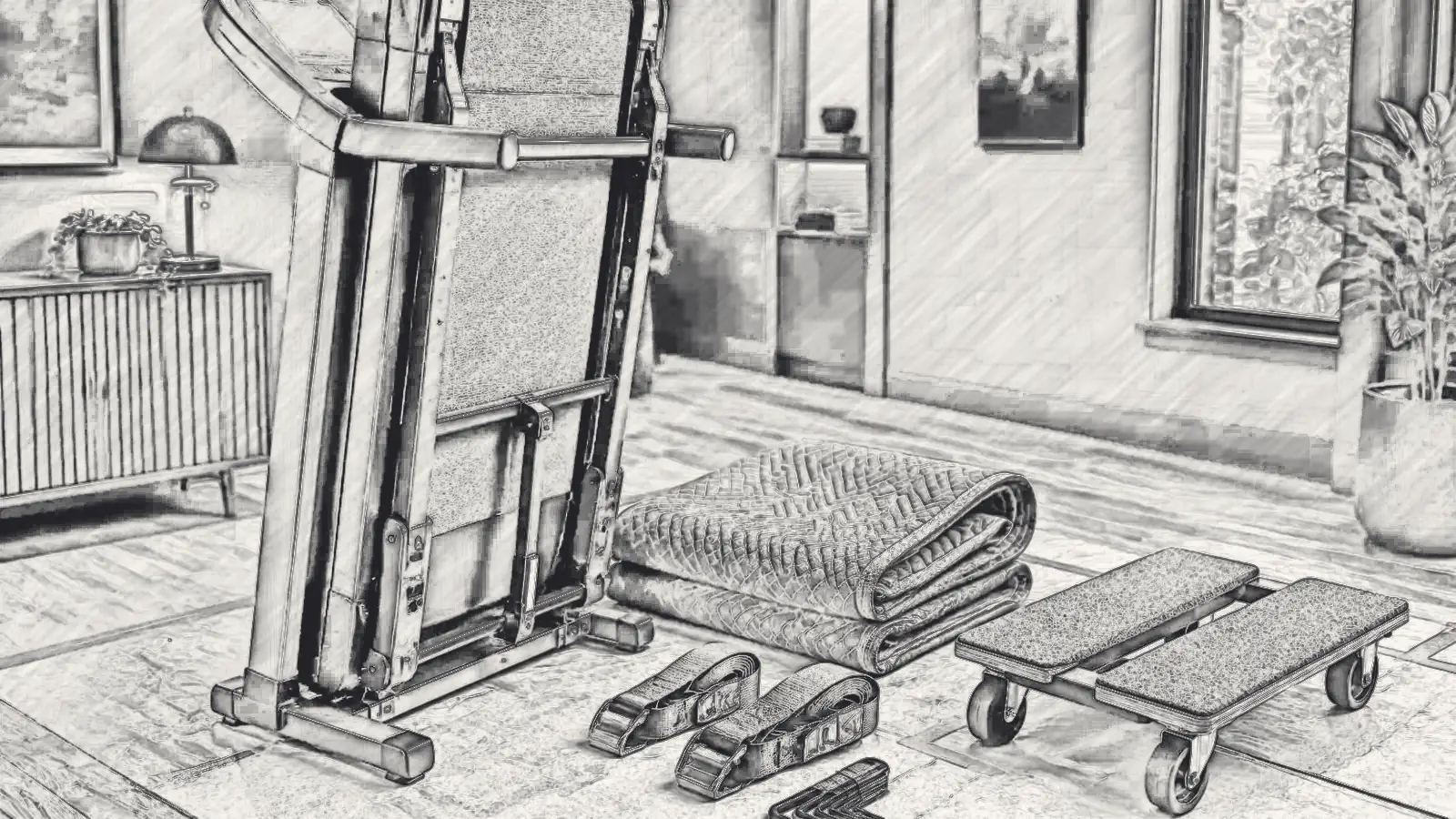
Protect the console independently if removed, keeping pressure off the display and connector sockets. Clean and dry contact surfaces before wrapping. Avoid applying adhesive to the running belt or plastic covers. Secure any approved folding latch according to the instructions and do not use it as a lifting handle. Protect floors for the concentrated load at the motor end and at any moving-aid wheels. A soft blanket alone will not prevent a heavy wheel indenting a delicate surface.
Protection must remain secure while people are working. Loose blankets underfoot can slip, and thin cardboard does not spread a concentrated wheel load reliably. Check that any floor covering is compatible with the finish, keep joints flat and leave thresholds visible. Do not fix adhesive directly to upholstery, painted frames or polished surfaces. Inspect the protection again after the first movement: a shifted runner or caught edge should be corrected before the next part of the job starts.
Move on level floors and reassess stairs
On a clear level floor, built-in wheels may be suitable when used exactly as described by the manufacturer. They do not make the treadmill suitable for stair movement. The motor end often creates uneven balance, so never guess where helpers should stand. Stair work requires a model-specific access and handling assessment, suitable equipment and competent people. Do not attempt it by tying ropes around the console or asking someone below to steady an uncontrolled descent.
Agree the sequence and stopping points with everyone involved before touching the equipment. Use clear commands from one nominated person and keep communication possible throughout. Hands and feet must stay away from pinch points, hinges and the underside of suspended parts. Never try to catch a falling machine. If balance changes unexpectedly, stop using the agreed controlled method and reassess; adding an extra person at the last moment does not repair an unsuitable route or lifting arrangement.
How to move a treadmill without treating its folding mechanism or transport wheels as a complete moving plan. if you are asking “how do i move a treadmill”
Check the model and route
Confirm the model-specific requirements and document the current condition before starting.
Set the instructed transport position
Prepare a clear working area and obtain the instructions, protection and competent help required.
Isolate and label connections
Follow the permitted sequence, label components and keep unsupported or moving parts controlled.
Protect and transfer the base
Use the assessed method, maintaining stable support and keeping people clear of crush zones.
Reassemble and complete prescribed tests
Reconcile parts and complete the specified checks before returning the equipment to use.
Choose a suitable van and secure the base
Use the permitted transport orientation and a vehicle loading system suited to the actual machine. A folded treadmill still needs restraint against unfolding, tipping and sliding. Protect straps at edges and use approved frame points, keeping pressure off the belt, rollers and display. Do not stand a machine on its end merely to make other furniture fit. Position separate console components where they cannot be crushed by the deck or loose weights if the vehicle brakes.
A vehicle's available space is only one part of the transport decision. Check payload, axle loading, anchorage ratings and the suitability of ramps or lifting equipment. Include packing materials and every separate component in the load assessment. Keep access to restraints available and protect straps from sharp edges. Do not use trim panels, grab handles or unverified fittings as load anchors. Where a safe loading arrangement cannot be established, change the vehicle or book a suitably equipped moving service.
Reassemble, level and test methodically
Return the treadmill to its approved operating position before removing supports. Reconnect labelled wiring without trapping it inside uprights, then refit covers and fasteners as instructed. Check levelling, folding locks, safety-key operation and clearances. Follow the manual’s recommissioning procedure before anyone steps onto the belt. If belt tracking, unusual noise or error messages appear, stop and investigate rather than increasing speed to see whether the problem clears. Do not improvise electrical repairs after a move.
Record what has been completed and what remains out of service. Keep loose accessories together and make sure another person cannot mistake a partly finished installation for equipment ready to use. Replace any missing, damaged or incorrect fasteners with the specified parts rather than convenient substitutes. Any electrical fault, damaged cable or uncertain structural connection needs assessment before use. Start functional checks only after the machine is stable, correctly assembled and clear of packaging and tools.
Arrange treadmill moving help before the difficult stage
Book help before a treadmill is stranded in a corridor or partly dismantled on a landing. Send photographs showing the entire route, not just the machine. Tell GymMovers.co.uk if the incline is raised, the fold lock is unreliable or the console wiring has already been disconnected. These details can change the handling plan. Ask for the agreed scope to include any required reassembly and checks, and clarify whether access preparation must be completed before the crew arrives.
Send the same information to everyone quoting so that the proposed scope can be compared fairly. Include photographs, model details, access restrictions, parking arrangements and the required completion date. Ask what dismantling, packing, transport, reassembly and checks are included, and disclose anything already damaged or incomplete. Confirm arrangements for building access and any third party approvals in writing. A useful quotation identifies the work and assumptions clearly rather than leaving difficult access or unfinished assembly to be resolved on the day.
What our customers say
Verified 5/5 Google feedback for Removals & Storage Experts Ltd (Removals and Storage X).
“We had a fantastic service from this company. Very responsive. On time. Nothing was too much. Friendly movers.”
Justine · a year ago
“Brilliant team! Everyone has been extremely efficient and friendly throughout the whole process (from admin team to the removal guys).”
Maria · 5 years ago
“Would definitely recommend for an office move. Company were very responsive and booking the move was straightforward. The team on the day were on time, friendly, polite and professional; they got the job done. It could not have gone more smoothly.”
Jemma · 6 years ago